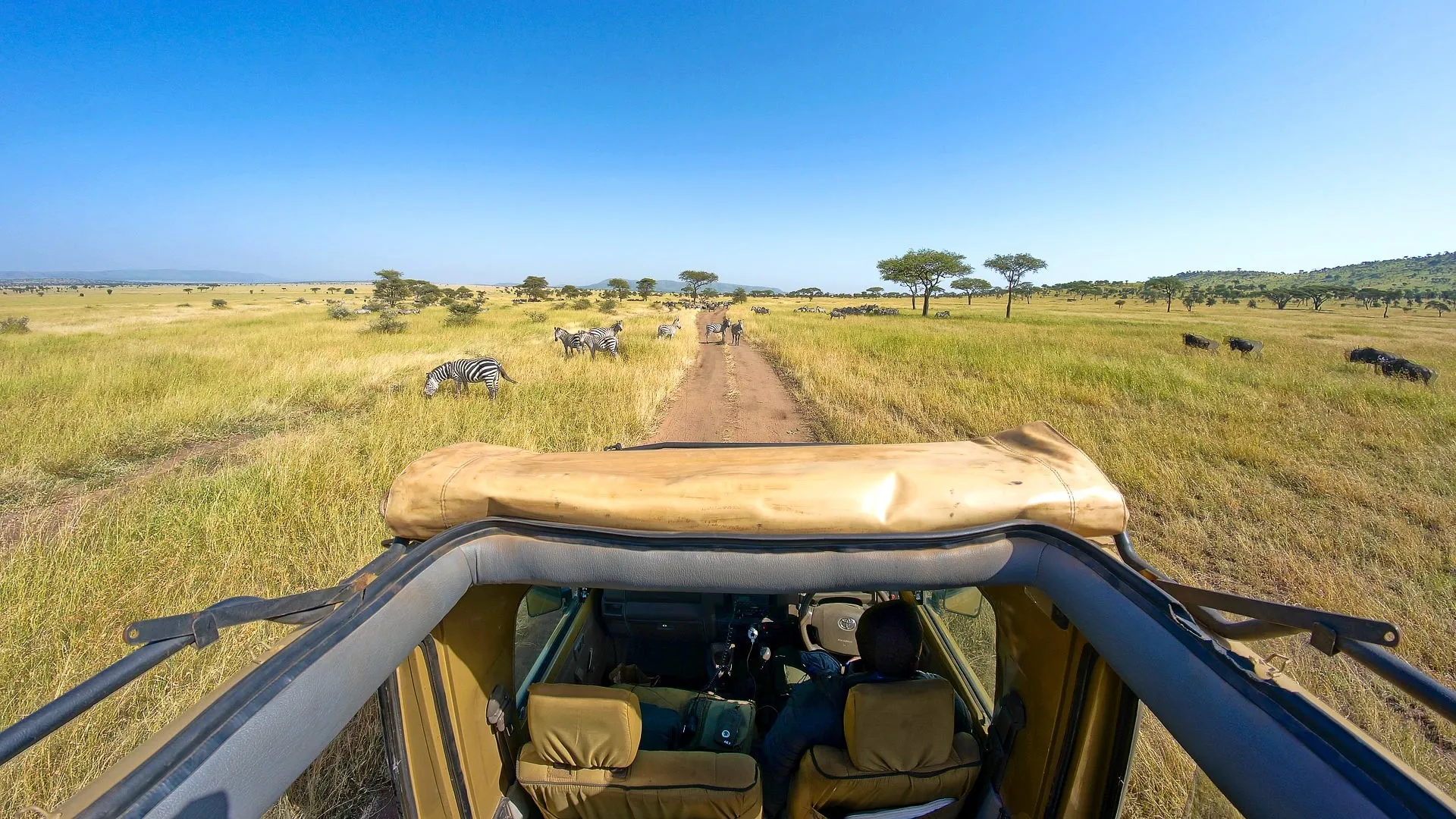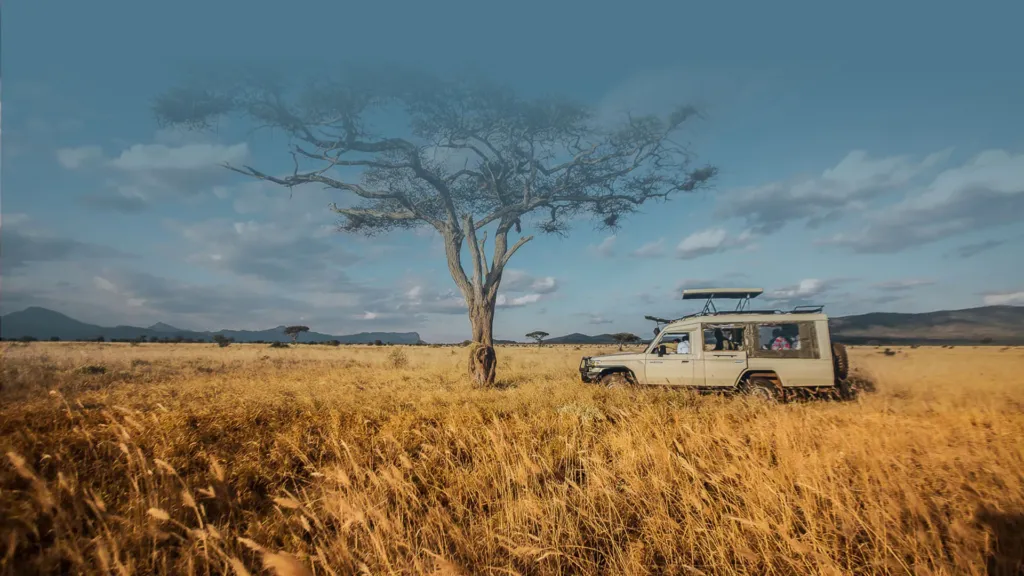
Eleven days across five of Kenya's defining landscapes, Tsavo's vast plains and red elephants, Amboseli beneath Kilimanjaro, a rhino sanctuary at Lake Nakuru, and three days in the Masai Mara.
This is the long version, built for travellers who want to see Kenya properly rather than sample one corner of it.
It opens in Tsavo, the country’s largest protected ecosystem, two full parks split by the Nairobi–Mombasa road, open plains, the Yatta Plateau’s lava ridge, Mzima Springs’ underwater viewing chamber, and elephant herds that gather here in numbers that rival anywhere in Africa. From there it continues to Amboseli, close enough to Kilimanjaro that the mountain fills the horizon on a clear morning, and elephant families that have been individually known and studied since 1972.
The route then turns north to Lake Nakuru, a fenced sanctuary holding a genuinely significant population of both black and white rhino, and a real chance at Rothschild’s giraffe, before closing with three full days in the Masai Mara, Kenya’s most celebrated reserve, resident lion prides, open plains, and, depending on the season, the tail end of the wildebeest migration itself.
Five landscapes, each a genuinely different mood, connected into one continuous eleven-day circuit rather than five separate trips stitched together.
The parts of this particular route past travellers mention most
Vast Tsavo plains, Kilimanjaro's backdrop at Amboseli, a rhino sanctuary at Lake Nakuru, and three days in the Masai Mara, each a genuinely different chapter of the same trip.
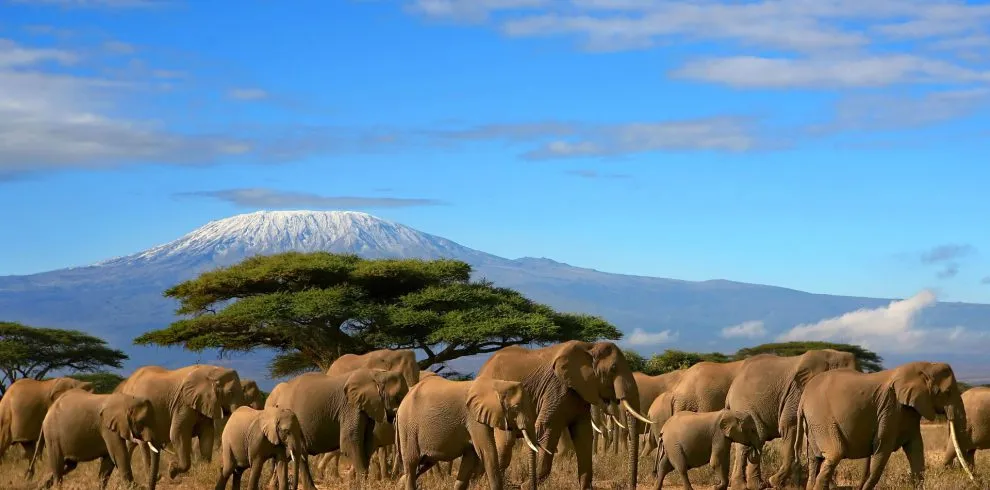
Tsavo and Amboseli both hold some of the largest elephant concentrations anywhere in Africa, herds gathering in the hundreds rather than the dozens.
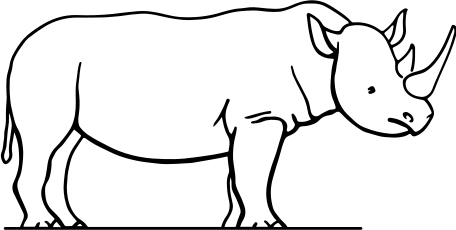
Lake Nakuru's fenced sanctuary protects a genuinely significant population of both species, more reliable sightings than almost anywhere else in Kenya.
The Masai Mara closes this circuit with resident lion prides, open plains, and, depending on the season, the tail of the wildebeest migration itself.
Africa's tallest mountain rises directly across the border from Amboseli, clearest in the soft light of early morning.
A starting shape: pace, order and length of each stage are all adjustable.
The drive out of Mombasa covers around 100 kilometres, two to four hours depending on the gate, the coastal humidity giving way to the dry, wide country Tsavo is known for well before the park boundary comes into view. It's a comfortable, well-travelled route, more a gentle unwinding into safari country than a journey to be endured.
Arrival is timed for lunch, with the first game drive setting out in the softer light of early afternoon, open plains, a first distant view of the Yatta Plateau's flat-topped ridge, and, with real luck, one of the park's famous large elephant herds.
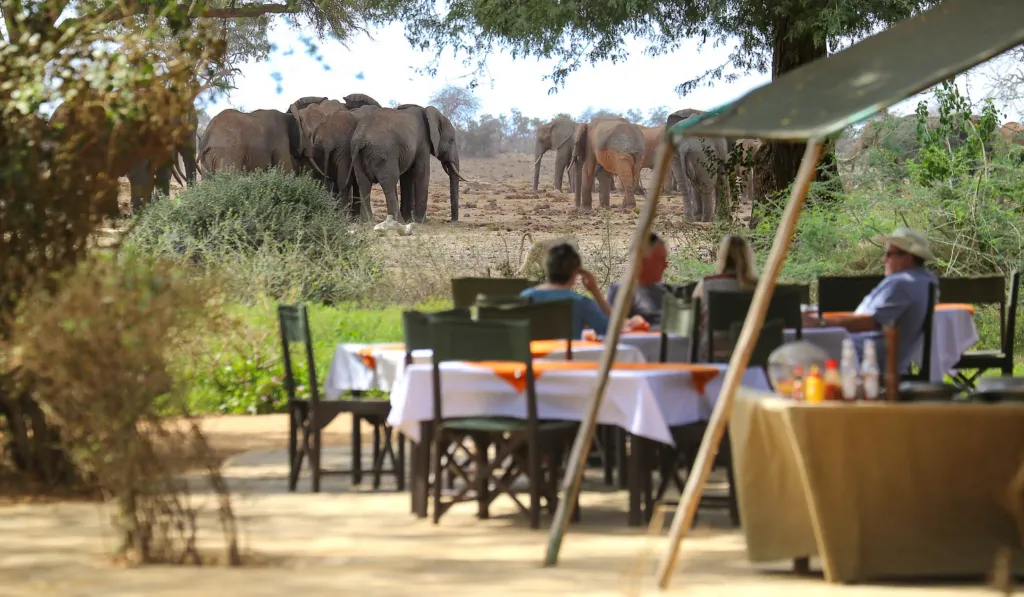
A lodge overlooking a waterhole near Voi · One night here, close to the park's southern game-viewing circuit.
The day begins early, while the plains are still cool and the resident wildlife at its most active. The morning drive moves toward the Galana River, tracing it to Lugard Falls, a rare stretch of white water where the river narrows and tumbles briefly over rock, a striking sight in a park otherwise defined by flat, open ground.
After a midday rest at camp, the afternoon drive turns toward Aruba Dam, where wildlife gathers to permanent water through the dry months, with the Yatta Plateau's long lava ridge visible along the western horizon for much of the day.
Second night at the same lodge overlooking a waterhole near Voi · Second night here
The transfer between the two Tsavo parks is comparatively short, a couple of hours across ground shared by both, and the change in scenery is immediate. Tsavo East's flat, open plains give way to Tsavo West's hillier, more volcanic terrain, a landscape shaped by lava rather than just grass, the two parks feel genuinely distinct despite sitting side by side.
Arrival is timed for lunch, with an afternoon game drive taking in the park's early character, red-dusted elephant, and, on a clear day, the first glimpse of Kilimanjaro on the southern horizon.
A lodge overlooking a waterhole in Tsavo West's centre · One night here, close to Mzima Springs and the park's main game-viewing circuit.
The morning is given to Mzima Springs, a natural spring so clear that a glass-walled viewing chamber lets you watch hippo and crocodile move beneath the surface rather than only from the bank, a genuinely unusual way to see both species. From there, the drive continues past the Shetani lava flow, a black volcanic field frozen mid-flow, and Chaimu Hill, a short climb rewarded with a view across much of the park.
The afternoon turns toward Ngulia Rhino Sanctuary, a fenced, actively protected population that makes black rhino sightings here meaningfully more reliable than in most open-range parks. Elephant, buffalo and lion are all a normal part of a full day here, against scenery unlike anywhere else in this circuit.
Second night at the same lodge overlooking a waterhole in Tsavo West's centre · Second night here.
The drive from Tsavo West to Amboseli takes around three hours via Chyulu Gate, the volcanic Chyulu Hills visible for much of the route, a genuinely scenic transfer rather than dead travel time between two stops. The landscape opens out again as the vehicle approaches Amboseli, flat, dust-pale plains with Kilimanjaro's snow-capped summit, cloud permitting, rising directly ahead.
Arrival is timed for lunch, with the first game drive setting out in the softer light of late afternoon, elephant herds moving toward the swamps, the mountain beginning to clear of cloud, and the particular quality of dust and gold light that has made this park one of the most photographed places in Africa.
A tented camp within view of Mount Kilimanjaro · One night here, close enough to the swamps for wildlife to pass through camp itself.
The day begins before the sun properly clears the horizon, when Kilimanjaro's summit is at its most reliably visible. The morning drive moves toward Amboseli's two permanent swamps, Enkongo Narok and Longinye, fed year round by underground water flowing from the mountain's own glaciers, where elephant, hippo and buffalo gather regardless of season. Decades of elephant research have left these herds unusually calm around vehicles, and long, unhurried sightings are the rule here rather than the exception.
The afternoon is given to Observation Hill, the only point in the park where visitors may step out on foot, a short climb to a view that takes in the swamps, the herds moving between them, and Kilimanjaro itself in a single sweep, before a second game drive timed for the golden hour.
Second night at the same camp within view of Mount Kilimanjaro · Second night here.
This is the longest transfer of the trip, roughly six and a half to seven hours, routing back through or near Nairobi before continuing into the Rift Valley toward Lake Nakuru. A comfortable stop along the way, a proper lunch break rather than a rushed one, helps break up a day that covers considerable ground.
The scenery changes markedly as the road climbs into the Rift Valley, the flat plains around Amboseli giving way to greener, hillier country, with the lake itself, held inside a fenced sanctuary boundary, coming into view as the drive nears its end. Arrival is timed for the evening, with the first proper game drive to follow the next morning.
A lodge overlooking Lake Nakuru · One night here, inside the sanctuary's fenced boundary.
The morning game drive covers Lake Nakuru's fenced sanctuary, home to a genuinely significant population of both black and white rhino, sightings here are meaningfully more reliable than in most open-range parks. Rothschild's giraffe, an endangered subspecies reintroduced to the park for its own protection, are a regular sight moving through the acacia woodland along the shore, and the lake itself, depending on water levels and the season, sometimes still holds flamingo, though nowhere near the scale of the flocks this park was once famous for.
After lunch, the drive continues west, roughly four to five hours, into the Great Rift Valley's floor and up the far side toward the Masai Mara, the landscape opening into the wide, rolling grassland the reserve is known for as the vehicle approaches camp in the late afternoon.
Enkakenya Camp, an unfenced camp on the Olare Orok River · Three nights here, right inside the reserve boundary.
Mornings begin early, while the light is still soft and the air still carries the night's cool, tracing resident lion prides across plains that seem to stretch further with every mile. Your guide reads the morning off fresh tracks and the sightings other camps are radioing in, letting the sightings decide the route rather than a fixed schedule. Depending on the season, this stretch of the Mara may also intersect with the tail end of the wildebeest migration, worth asking your specialist what the herds are doing on your specific dates.
Afternoons trace the Mara River itself, where hippo and crocodile hold their stretch of water year round, and the light turns the particular deep gold the Mara is famous for as the day closes. Both nights are spent at the same camp, so nothing about this stretch feels rushed.
Second and third nights at Enkakenya Camp · Same unfenced camp on the Olare Orok River, both nights
There is time for one last drive before breakfast, unhurried, following whatever the plains offer on a final morning rather than working through a checklist. Eleven days in, this tends to be the moment the whole circuit comes into focus, plains, springs, a mountain, a rhino sanctuary and open grassland, each a genuinely different chapter of the same trip.
A short transfer covers the drive to the airstrip. From there, a direct scheduled flight reaches Nairobi's Wilson Airport in around an hour to ninety minutes, or, if Mombasa is your onward destination, a scheduled multi-stop flight covers the same route in around three hours rather than a single direct hop, your specialist will confirm the specific routing once flights are booked.
Based on past travellers' sightings across this specific five-park circuit, here's roughly what to expect.
Five genuinely different stays across eleven days, each placed for the landscape it belongs to, closing with three nights at Enkakenya Camp on the Mara's Olare Orok River.
Park fees paid across this route fund the Kenya Wildlife Service's operations at Tsavo East, Tsavo West, Amboseli and Lake Nakuru, and the Masai Mara's own conservancy and community fee structures, supporting ranger patrols, rhino monitoring and community employment across five separate landscapes.
Entry fees collected across Tsavo East, Tsavo West, Amboseli and Lake Nakuru go to the Kenya Wildlife Service, which funds ranger salaries, anti-poaching patrols and infrastructure across Kenya's protected areas.
Lake Nakuru's fenced boundary protects both its black and white rhino populations with dedicated ranger patrols, one of Kenya's most significant sanctuaries for either species.
The camp used on the Mara leg works closely with surrounding Maasai communities on staffing, keeping a share of the trip's spend circulating locally.
Eleven days is a starting point, not a ceiling. Add a night to any single stage, particularly the Masai Mara if the migration is timed to be nearby on your dates, or close the trip with a beach extension instead of flying straight home, your specialist will work from here.
With the route as a starting point, your specialist will adjust the pace, camps and add-ons until the itinerary feels like yours, not a template.
Start tailoring this safari
Seven days, Tsavo East's plains, Taita Hills' waterhole lodges, and Diani's white-sand coast
A private Kenya coast to Masai Mara safari: Tsavo East, Amboseli, Lake Naivasha and the Mara,…
A private luxury Tsavo East safari from Nairobi: three nights amongst the red elephants, then home…
A full day across Tsavo East’s open plains, one of the largest national parks on Earth, tracking the Galana River to Lugard Falls and Aruba Dam, with elephant herds that gather here in some of the largest concentrations anywhere in Africa, and the Yatta Plateau’s near-300-kilometre lava ridge visible along the horizon for much of the day
Each stage gets real time, not a rushed overnight, so eleven days reflects a genuine, unhurried pace across five distinct landscapes rather than padding. Shorter versions covering fewer parks exist elsewhere on this site if your schedule doesn’t stretch this far.
Possibly, but not reliably, and not at the scale this park was once famous for. Rising water levels have genuinely reduced flamingo numbers here in recent years, most flocks have shifted to other Rift Valley lakes. Lake Nakuru’s real strength today is its rhino sanctuary and Rothschild’s giraffe population.
It depends on the season, camp and lodge choice, and any add-on activities, so there isn’t one number that fits every trip. Tell us your dates and we’ll put together a tailored quote.
There’s a real scheduled service, but it routes through one or two other airstrips along the way rather than flying direct, so the total journey takes around three hours. Flying to Nairobi instead is quicker, around an hour to ninety minutes, if that better suits your onward plans.
Not guaranteed, migration timing shifts year to year with the rains, but the Mara’s resident lion, leopard and cheetah populations remain reliable regardless of where the herds happen to be on your specific dates.
Tell us your dates and we'll confirm whether the timing works, then adjust the route from there.
Start planning this trip