Nine unhurried days from Tarangire's baobabs to the Ngorongoro Crater, the Serengeti's endless plains and the Masai Mara, privately guided across two countries.
There are journeys that merely visit Africa, and there are those that take the measure of it.
This luxury Kenya and Tanzania safari belongs to the second kind: nine days that begin amongst the baobabs and elephant herds of Tarangire, ascend to the rim of the Ngorongoro Crater, and descend into its great volcanic bowl, one of the most densely populated wildlife stages on the continent.
From the crater the road runs west to the Serengeti, where the plains continue to every horizon, and thence, by air and road, across the border into Kenya for two days in the Masai Mara, the northern reach of the very same ecosystem. One finds the Serengeti and the Mara to be a single landscape divided by a frontier, and this combined Kenya Tanzania safari is arranged so that both halves may be savoured.
Five stays, one border crossing and a closing flight to Nairobi make this a complete 9-day Kenya Tanzania safari, privately guided and paced to the traveller rather than the timetable, for those who would rather see the whole of the famous circuit than a fragment of it.
The parts of this particular route past travellers mention most
A quieter park of about 2,850 square kilometres, famous for its ancient baobab trees and one of the densest elephant populations in East Africa.
A collapsed volcanic caldera some 20 kilometres across and 600 metres deep, holding an estimated 25,000 large animals that stay resident all year.
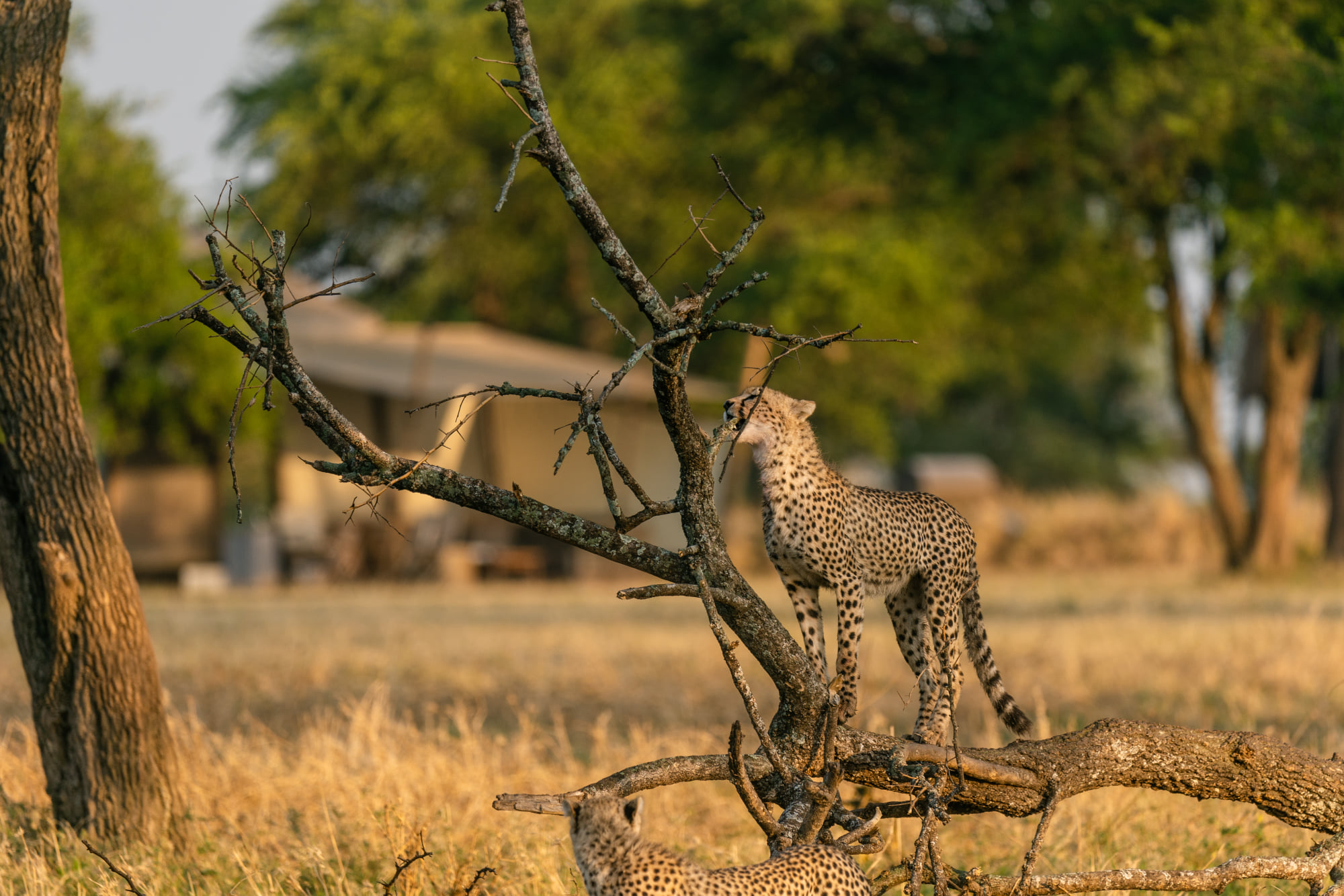
Seronera's lion prides have been studied continuously since the 1960s, and leopard are regularly found resting in the riverine forest along the Seronera River.
A stop inside the Conservation Area at one of the most important palaeoanthropology sites on Earth, where fossil finds reshaped our understanding of early human evolution.
The Serengeti is roughly ten times the size of the Masai Mara, yet the two form one continuous landscape, and this route crosses the frontier between them by air and road.
Open plains, the Mara River and a camp on the Olare Orok River, with the migration's river crossings possible from roughly July to October.
A starting shape: pace, order and length of each stage are all adjustable.
Your journey opens at Kilimanjaro International Airport, where your guide awaits and a private transfer carries you some 50 kilometres to Arusha, the gateway to Tanzania's northern safari circuit. On a clear evening the summit of Mount Meru may be seen above the town, a first and most agreeable hint of the country to come.
The remainder of the day is yours to recover from the journey, with a briefing on the days ahead and an early night, for tomorrow the road leads into the wild. Arusha is the one night of this itinerary spent in a town, and it is a civilised place to begin.
A lodge in Arusha · One night here, before the drive to Tarangire.
The road from Arusha runs roughly two to three hours to Tarangire National Park, a quieter, less visited reserve of about 2,850 square kilometres where ancient baobab trees stand singly across the plains like the columns of some vanished temple. Arrival is timed for luncheon, after which the first game drive follows the Tarangire River.
The river is the great gathering place of the region, and from roughly June to November, when the surrounding country dries, zebra, wildebeest, buffalo and elephant come to it in their thousands. Tarangire is renowned for its high density of elephant, and has been recognised as a Lion Conservation Unit since 2005, a distinction that speaks to the importance of this wider ecosystem for the species.
A lodge or tented camp in or beside Tarangire National Park · One night here, with an evening and a dawn among the baobabs.
After a final morning game drive, the road climbs from the Rift Valley floor through Karatu and its coffee farms to the Ngorongoro Conservation Area, roughly three and a half to four hours in all. The landscape alters as one ascends, cultivated hillsides yielding to highland forest, and the first view down into the crater, twenty kilometres across and framed by its own far wall, is a moment that tends to be remembered long after the details of the journey have faded.
Rather than descending the same afternoon, this itinerary reserves the crater floor for a full day tomorrow, so the evening is left to arrival, a short walk along the rim if energy allows, and dinner above the caldera as the light fades. It is a gentle prelude to the grandest day of the journey.
A lodge on the Ngorongoro Crater rim · Two nights here, with the crater floor visible below the dining room.
The descent begins early, down one of the steep access roads into a collapsed volcanic caldera holding an estimated 25,000 large animals. Lion, wildebeest, zebra and buffalo are the ordinary company of a morning, the crater is home to one of the densest lion populations in Africa, and black rhino are a real if less certain possibility, the crater's population being amongst the largest single groups remaining in Tanzania. Giraffe are the one great animal one will not find on the floor.
Luncheon is a picnic beside a spring-fed pool, hippo included, before an afternoon spent on different ground: the Lerai Forest, where old bull elephants pass their days, and the open plains at the centre, where wildebeest and zebra graze. The ascent to the rim is timed for late afternoon, in good season for a second evening above the caldera.
Second night on the Ngorongoro Crater rim · Second night here, same rim views
After a leisurely breakfast with the crater still spread out below, the road leads west and out of the Conservation Area, pausing at Olduvai Gorge, one of the most important palaeoanthropology sites on Earth, where fossil discoveries reshaped scientific understanding of early human evolution. A short visit lends the morning a different and thoughtful character before the road turns once more towards wildlife country.
The track drops onto the Serengeti's plains and continues to Seronera, the heart of the park and its most reliable game-viewing sector throughout the year, a journey of roughly three to five hours depending on stops and gate formalities. Arrival is timed for an afternoon game drive through ground that holds resident lion and leopard in numbers to rival anywhere on the continent.
A lodge or tented camp in central Serengeti, near Seronera · Two nights here, in the park's most reliable game-viewing sector.
The day begins early, whilst Seronera's resident prides are at their most active, the morning drive passing through open grass and amongst the granite kopjes, ancient rock rising from plains that run unbroken to every horizon. According to the month, this stretch of the park may also intersect the Great Migration's herds, and your specialist will advise what they are doing on your dates.
After a midday rest at camp, the afternoon follows the Seronera River's riverine forest, prime leopard habitat and one of the most dependable places in Africa to find a leopard resting in a tree. A dawn hot air balloon safari is available as an add-on for those who would see the same plains from above, with breakfast served in the bush.
Second night in central Serengeti · Second night here.
The Serengeti and the Masai Mara are one continuous ecosystem, yet the frontier between them is a real one, with no direct scheduled flight across it, and so today is a cross-border transfer by air and road: a morning flight from the Serengeti to Tarime, a short road transfer over the Isebania border with immigration formalities, then a second flight from Migori into the Mara.
Vehicles and guides change at the border, as Tanzanian and Kenyan safari vehicles do not cross, and the connection runs only in the high seasons, mid-December to the end of March and July to the end of October, so your specialist confirms the routing for your dates. Arrival in the Mara is in the early afternoon, with a late-afternoon game drive to make the acquaintance of the Kenyan plains.
Enkakenya Camp, an unfenced tented camp on the Olare Orok River, inside the Masai Mara reserve · Two nights here, positioned for a full day exploring the reserve.
The Masai Mara National Reserve covers about 1,510 square kilometres, small enough to be traversed in a day and rich enough to demand one, and a full day of game drives crosses open grassland and the riverine forest along the Mara River, home to the Big Five and, from roughly July to October, the Great Migration's river crossings. Luncheon is taken in the bush or at camp.
The afternoon follows the Mara River itself, where hippo and crocodile keep their stretch of water throughout the year, and the light takes on the deep gold for which the reserve is celebrated. A dawn hot air balloon safari is available as an add-on, drifting over the same grassland as the sun rises, followed by a breakfast laid in the bush.
Second night at Enkakenya Camp · Second night here.
There is time for one final drive before breakfast, unhurried, following whatever the plains may offer on a last morning. A short transfer leads to the airstrip, and a scheduled flight reaches Nairobi's Wilson Airport in under an hour and a half, a fraction of the five to six hours the same journey takes by road via Narok.
Wilson Airport is separate from Jomo Kenyatta International, roughly 30 to 45 minutes apart by road, so the transfer is timed to connect with an evening international departure. Nine days after arriving, the journey closes having taken in Tarangire's baobabs, the Ngorongoro Crater's enclosed floor, the Serengeti's open plains and the Masai Mara's rivers and grassland, two countries and one continuous landscape.
Based on past travellers' experiences, here's what this route is really about.
Five stays across two countries, from a lodge in Arusha to a perch on the Ngorongoro rim and Enkakenya Camp in the Masai Mara, each placed for the landscape it belongs to.
Park and reserve fees across this route fund ranger operations and monitoring in two countries, and the Ngorongoro Conservation Area is a rare working example of wildlife and people sharing the same land.
Maasai communities have lived and grazed cattle inside the Ngorongoro Conservation Area since its boundary was drawn in 1959, a deliberate alternative to excluding people from conservation land.
Poaching cut the crater's black rhino from over 100 in the 1960s to fewer than 20 by the mid-1980s, and today's population of around 30 is the largest single group left in Tanzania.
Tarangire has been recognised as a Lion Conservation Unit since 2005, a designation reflecting how much the wider ecosystem matters to the species, and entry fees paid there support the park's ranger operations.
The Serengeti and the Masai Mara protect the same migration landscape from either side of the border, and the fees paid on this route support ranger patrols in both.
Nine days is arranged for travellers who wish to see the famous northern circuit in full, and then cross into Kenya for the Mara. Add a night in the northern Serengeti for the migration, extend to the Mara River crossings, or close with a few days of beach at Diani or Zanzibar, your specialist will work from here.
With the route as a starting point, your specialist will adjust the pace, camps and add-ons until the itinerary feels like yours, not a template.
Start planning this safari
Ol Pejeta, Lake Naivasha, the Maasai Mara, Serengeti and Ngorongoro Crater on a 10-day family safari…
Seven days from the Ngorongoro Crater to the Serengeti and the Masai Mara, two countries, one…
A 9-day Tanzania journey through Tarangire's elephant herds, the Ngorongoro Crater, and two full days in…
Yes, once, on Day 7, from the Serengeti into the Masai Mara, by air and road with immigration formalities at the Isebania border, and with a vehicle and guide change on the way.
Most visitors need a Tanzanian visa and Kenya’s Electronic Travel Authorisation before the Day 7 crossing. The East Africa Tourist Visa covers Kenya, Uganda and Rwanda but not Tanzania, so your specialist confirms the exact requirements for your nationality before you book.
No. The air and road connection runs only from mid-December to the end of March and from July to the end of October, and needs at least two passengers. Your specialist confirms the routing and dates, and arranges an alternative if you are travelling outside those windows.
From roughly June to November, when the surrounding country dries and the Tarangire River draws zebra, wildebeest, buffalo and elephant in their thousands. Elephant are a highlight at any time of year.
No. Day 3 is the journey from Tarangire and an evening on the rim, and the full crater descent is Day 4, so the floor receives a whole unhurried day rather than an afternoon squeezed in after a long transfer.
It depends on your dates. The Mara River crossings are possible from roughly July to October, and the herds’ position in the Serengeti shifts through the year, so your specialist will advise what the herds are doing on your specific dates.
Black rhino are a real possibility in the Ngorongoro Crater and a rare sighting in the Serengeti and Masai Mara, but never guaranteed. White rhino do not naturally occur on this route.
The flight to Wilson Airport takes under an hour and a half, against five to six hours by road via Narok, and it allows the last morning to remain a game drive rather than a long road journey.
Tell us your dates and we'll confirm whether the timing works, then adjust the route from there.
Start planning this trip